
Our Market

Crises across the world are having a significant impact on millions of people’s lives and are fueling the burden of global poverty.

Food insecurity

From the conflict in Syria, Yemen, and South Sudan to food insecurity in the Horn of Africa, 2017 saw several severe crises in need of foreign assistance, according to Development Initiatives. A 2017 report around Global Humanitarian Assistance, details that there were 201 million people in 134 countries in need of international humanitarian assistance in 2017.

Humanitarian aid

While often connected, international humanitarian assistance is different from official development assistance (which is commonly referred to as foreign aid). Humanitarian aid is needed to assist during emergencies and in the aftermath, whereas development aid is meant to provide long-term assistance for ongoing structural issues, like systemic poverty, according to the Humanitarian Coalition.

Our driving factor

Conflict continues to be the driving factor for the need for much of the world’s humanitarian aid. International humanitarian assistance reached a new high last year, with the top five country donors contributing from $767 million to just over $6.6 billion each.

Why is there a need for HFL?

THE STORY ABOUT US


Problem: Despite advances made in the method of food production, malnutrition remains a worldwide crisis. Many relief feeding schemes are in operation at present, with varying degrees of success. Such food feeding operations rely on dry donated food such as maize, beans, rice, and bulk carbohydrates. The disadvantage this presents is that they are easily contaminated or infested with vermin and require cooking before eating. In a natural disaster situation, with no water, no power and no infrastructure, cooking becomes a major problem. It is our belief that food feeding schemes need a complete balanced and nutritious one-stop food in a bag solution.

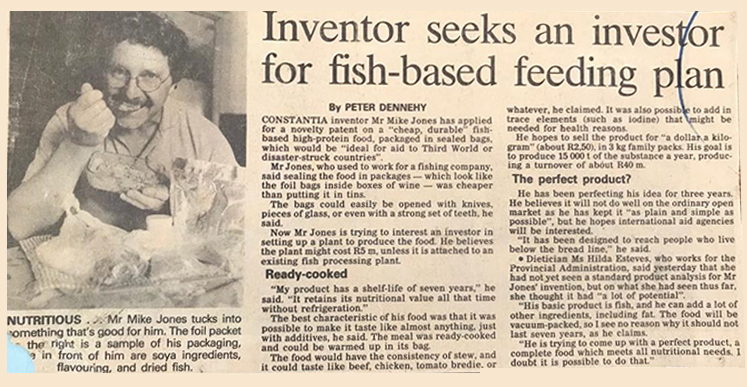
Solution: The concept originated historically while our Harvest For Life (HFL) team of experts worked in the fishing industry;  We noticed that tons of clean waste fish are being used to manufacture fish meal rather than being processed for human consumption.

The Harvest For Life process is a patented product with the official patent describing in detail the processing required.  Listed below are the benefits;

OUR PRODUCTS

Infant Read-Made Meals (Porridge)

Mineral and vitamin flavoured water

Hearty veg soup

Chicken and veg curry

Mutton and veg stew

Energy bars

Energy biscuits

All above meals in 410g can and or in same size foil pouches with minimum 2 year shelf life. Vitamins and minerals can be structured to your regional requirements.

The main

Dietary Requirement

Can be structured to meet any dietary requirements RDA. Content contains essential amino acids

Variety

Meals are available in four flavors, Curry, Beef, Fish in Tomato, Chicken, and Chili.

Virtually no waste

HFL converts fish bones into calcium products, which can be used by the pharmaceutical industry. HFL can manufacture pet food from any waste not used

Ease of use

Contents require no cooking or heating

Make bulk

Fish meal requires 4 tons of wet fish to make 1 ton of dry feed. HFL makes 1.5 tons of finished product per 1 ton of raw fish

Cost saving

 Fish meal plants cost 4 x more than an HFL plant. Fish meal can only feed animals, HFL feeds humans

Shelf Life

Long shelf life

MEET THE TEAM

FINANCIAL DIRECTOR
Slobodan Djukic
TECHNICAL/PRODUCTION DIRECTOR
Hamish Owen-Jones
FOOD TECHNOLOGIST DIRECTOR
Lizaan Pietrangeli
  

has been added to the cart. View Cart